
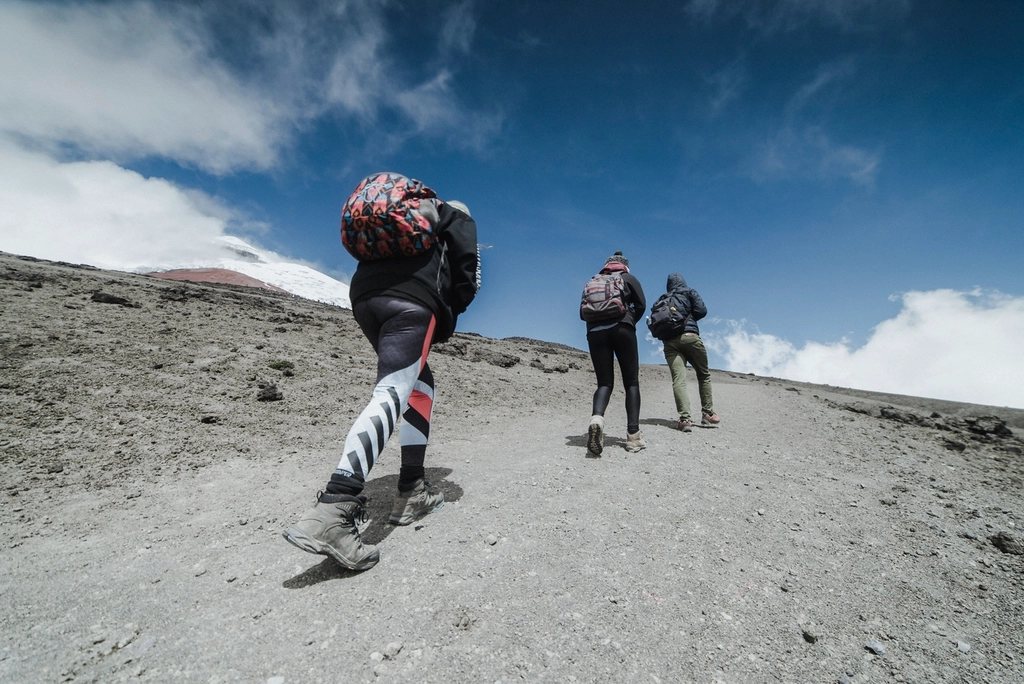
Most of the treks we love in South America begin high. Cusco sits at about 3,400 m, Huaraz at 3,050 m, La Paz at 3,640 m and its airport on the plateau of El Alto at just over 4,000 m. Fly in from sea level and your body is asked to do in an afternoon what it would prefer to do in a week. The passes come later and higher still: 4,215 m on the classic route to Machu Picchu, 4,630 m on the Salkantay crossing, 4,750 m at Punta Union in the Cordillera Blanca, and a string of passes near 5,000 m on the Huayhuash circuit. None of this is technical. All of it demands respect for the simple arithmetic of altitude.
What thin air actually does
The percentage of oxygen in the air does not change with altitude; the pressure does. At 4,000 m the barometric pressure is roughly 60 percent of its sea-level value, so each breath delivers about 60 percent of the oxygen. Your body compensates by breathing faster and deeper, by raising the heart rate, and over days by adjusting blood chemistry and eventually producing more red blood cells. The fast responses happen within hours. The slow ones take one to three weeks. Acclimatisation is simply the art of not asking for more than the fast responses can deliver while the slow ones catch up.
A pulse oximeter, if you carry one, will read in the mid-eighties at 4,000 m in a well-acclimatised walker, sometimes lower on the first night. The number matters less than the trend and, above all, less than how you feel. Treat the device as a curiosity, not as a verdict.
A schedule that works
The rule we plan around is well established: above 3,000 m, do not raise your sleeping altitude by more than 300 to 500 m per night, and take a rest day, or at least a day without net gain, for every 1,000 m climbed. “Climb high, sleep low” is the shorthand. A day walk to 4,300 m from a camp at 3,900 m is useful; sleeping at 4,300 m the same evening is not.
In practice this means arriving two or three days before a trek starts. In Cusco, use the first day for gentle wandering and the second for a walk to the ruins above the city at around 3,700 m. In Huaraz, the day hikes to lakes at 4,200 to 4,600 m are perfect acclimatisation outings precisely because you sleep back at 3,050 m. Around Lake Titicaca, at 3,810 m, simply walking the shore for a couple of days sets you up well for the Bolivian cordillera. Ecuador has a kinder profile: Quito sits at 2,850 m and the paramo treks rarely sleep above 4,000 m.
Three days is the minimum we would allow before sleeping above 4,000 m. Five is better. If your itinerary is fixed and short, choose a trek whose first two nights are low rather than trying to force the pace.
Recognising acute mountain sickness
Acute mountain sickness, or AMS, is common, unpleasant and usually self-limiting. It typically appears six to twelve hours after arriving at a new altitude. The defining symptom is headache, accompanied by one or more of the following: nausea or loss of appetite, unusual fatigue, dizziness, and broken sleep. Mild AMS feels like a hangover you did not earn. It is not a reason to abandon a trek, but it is a reason to stop going up. Stay at the same altitude, drink, eat what you can, and wait. Most people improve within 24 to 48 hours. If symptoms are unchanged or worse after a day, go down.
Two rules save lives. First, any illness at altitude is altitude illness until proven otherwise; do not explain away a headache as dehydration or a cough as a cold. Second, never go higher with symptoms, and never leave someone with symptoms alone.
The two conditions that kill
High altitude cerebral oedema, or HACE, is swelling of the brain. The signs are ataxia, which means a drunken, unsteady walk, plus confusion, irrational behaviour and severe headache. A simple test is to ask the person to walk heel to toe along a straight line. If they cannot, they descend now, in the dark if necessary, with help.
High altitude pulmonary oedema, or HAPE, is fluid in the lungs. It announces itself as breathlessness at rest, not just on the climb, along with a persistent cough, a crackling sound in the chest, blue lips and a marked drop in performance. It can develop quickly, often on the second or third night at a new altitude, and it is more common in fit young walkers who push hard. Descent is the treatment. Both conditions can appear without classic AMS first, and both improve dramatically with a loss of 500 to 1,000 m of altitude.
Medication, hydration and the things that do not work
Acetazolamide is a generic drug widely used to speed acclimatisation. A typical preventive dose is 125 mg twice a day, starting the day before ascent and continuing for two days at the highest sleeping altitude. It causes tingling fingers and makes fizzy drinks taste flat; it does not mask HACE or HAPE. Talk to a doctor before you travel, particularly if you have a sulfa allergy. Dexamethasone and nifedipine are emergency treatments, not prevention, and belong in a group first-aid kit with someone who knows how to use them.
Drink enough that your urine stays pale, which at altitude usually means three to four litres a day. Eat carbohydrates even when your appetite disappears. Avoid alcohol and sleeping pills for the first nights; both depress breathing. Coca leaf tea is traditional in Peru and Bolivia and harmless in the quantities served, but it is not a treatment for anything. Neither is willpower.
Deciding to descend
The hardest part of altitude is that the decision to turn around must be made by the person least able to make it. Agree the thresholds with your companions before you leave the trailhead, and write them down if you must. We use a simple list.
- Mild AMS: stop ascending, rest a night at the same altitude, reassess in the morning.
- AMS not improving after 24 hours, or getting worse: descend at least 500 m.
- Any ataxia, confusion or breathlessness at rest: descend immediately, with an escort, whatever the hour.
- Symptoms that vanish overnight after descent: you may re-ascend more slowly, usually after a full extra day.
Descending is not failure. On the Huayhuash circuit, dropping from a 4,700 m camp to a valley at 4,100 m costs an afternoon; on the Salkantay route, the lodges and villages below the pass are a natural safety valve. Plan your route knowing where those escape lines are, keep a night in reserve, and the Andes will let you come back for the passes another day.