
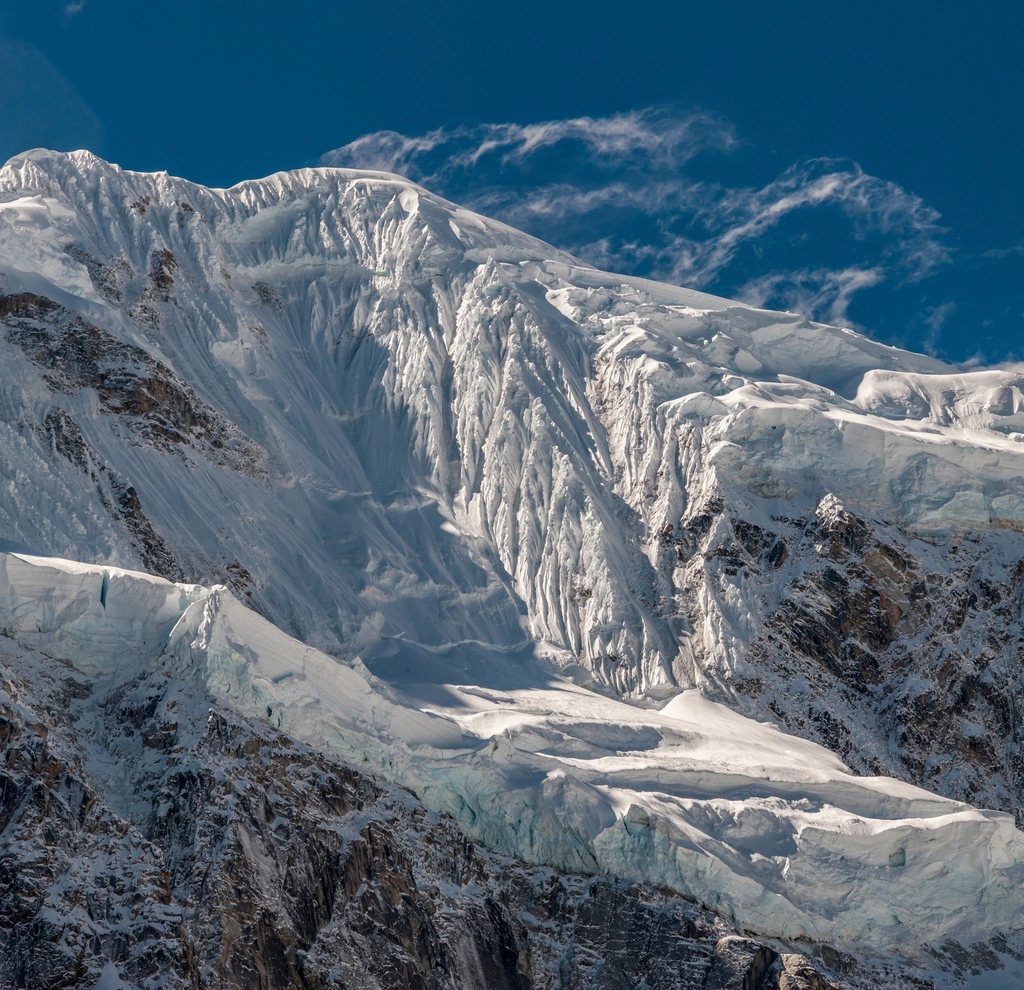
Every year the Inca Trail sells out months ahead, and every year a few thousand walkers discover that the mountain next door offers something arguably wilder. The Salkantay trek crosses a 4,630 m pass beneath one of the most beautiful peaks in the Cusco region, drops through cloud forest to the Urubamba valley and ends, like its famous cousin, at the gates of Machu Picchu. It needs no trekking permit, no lottery and no fixed departure date. What it does need is respect for altitude and a little planning around the one ticket that still matters.
The route in outline
The classic version takes five days and covers roughly 70 km. From the village of Mollepata (2,900 m), a track climbs to the meadows of Soraypampa at about 3,900 m, where most people spend the first night. Day two is the big one: up the valley to the Salkantay pass at 4,630 m, directly under the south face of Salkantay itself (6,271 m), then a long descent to the tree line and the hamlets around Chaullay near 2,900 m. Day three follows the Santa Teresa river down into warm, humid country at around 2,000 m, past coffee plots and banana trees. Day four climbs to the ruins of Llactapata, a small Inca site at 2,700 m with a direct sightline across the valley to Machu Picchu, then descends to the hydroelectric station and follows the railway line on foot for 10 km to Aguas Calientes. Day five is the visit itself.
Why 4,630 m deserves your attention
The pass is higher than anything on the Inca Trail, whose highest point, Dead Woman’s Pass, sits at 4,215 m. At 4,630 m the air holds roughly 57 percent of the oxygen available at sea level. If you arrive in Cusco (3,400 m) from the coast and start walking two days later, the pass will hurt. We recommend at least three nights at altitude before the trek, ideally with a day walk to 4,000 m or more, and a slow, steady pace on the morning of the crossing. Headache, poor sleep and loss of appetite are normal warnings; confusion, a wet cough or the inability to walk in a straight line are not, and they mean descending immediately. The pass is not a place to push through symptoms, because the only quick way down is the way you came up.
Cold is the other factor. Night temperatures at Soraypampa regularly fall below freezing between May and August, and the pass can see snow in any month. A sleeping bag rated to at least minus 10 degrees, a warm hat and gloves and a proper shell jacket are not optional.
Humantay lake and the side trips worth the effort
From Soraypampa, a steep climb of 1.5 to 2 hours reaches Humantay lake at about 4,200 m, a glacial tarn of an almost unreasonable turquoise below Humantay peak (5,473 m). It is the most photographed spot on the route and a sensible acclimatisation walk on the afternoon of arrival. Some itineraries add a night at a higher camp near 4,300 m to shorten the pass day, or a detour to a second lake on the far side of the pass. On day three or four, a few hours in the coffee farms around Lucmabamba are a pleasant contrast to the ice and stone of the high country.
The permit question, honestly
The Salkantay trail itself is not regulated by a quota. You can walk it independently, with mules or with a guide, and you can start on any day of the year. That said, three things still require advance thought. First, the entrance ticket to Machu Picchu is limited to a fixed daily number split into timed entry slots and set circuits, and in high season those sell out weeks ahead. Second, if you want to climb Huayna Picchu or Machu Picchu mountain, those are separate, smaller quotas and go faster still. Third, the return train from Aguas Calientes to the Sacred Valley has limited seats on the cheaper services. Book the site ticket first, then plan the trek backwards from that date.
Seasons and timing
The dry season from May to September brings the clearest skies and the coldest nights. June, July and August are the busiest months, both on the trail and at the ruins. April and October are quieter shoulder months with a higher chance of afternoon rain on the forested sections but generally fine mornings on the pass. From December to March the trail stays open, unlike the Inca Trail, which closes in February, but expect heavy rain, mud on the lower sections and occasionally a snow-covered pass. If you walk in the wet season, budget an extra day for delays and carry proper waterproofs rather than a poncho alone.
Independent or supported?
The route is well marked and passes through settlements with basic lodging and shops almost every day, so an independent trek is realistic for experienced walkers. Camping is possible at Soraypampa, at the foot of the pass and around Chaullay, and simple beds are available further down. A supported trek with mules and a cook removes the weight of camping gear, which matters at 4,600 m, and adds local knowledge of weather and river crossings. Either way, the essentials are the same:
- Three or more nights of acclimatisation in Cusco or the Sacred Valley before starting.
- Machu Picchu entry ticket and train seat booked before the trek, not after.
- Cash in small notes for camp fees, showers and the occasional soup stall.
- A sleeping bag for minus 10 degrees, a headtorch, sun protection and blister care.
- Water treatment for the lower valleys, where streams pass through farmland.
The Salkantay is not a secret any more, and on a July morning the pass can be busy. But it remains a proper mountain crossing, with a glacier close enough to hear and a descent that runs from ice to orchids in a single day. If the Inca Trail was your plan and the permits are gone, this is not the consolation prize. For many of us, it is the better walk.
Read next: Andean Mountains: How the Range Is Built and What It Means for Trekking