
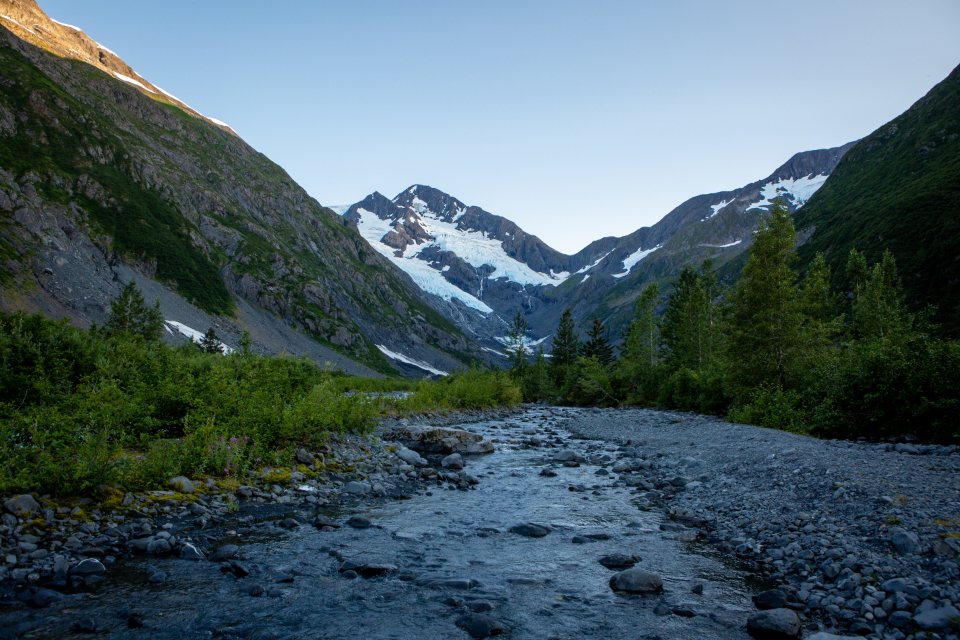
The rivers that give us the most trouble in South America are rarely the big ones. Big rivers have bridges, or at least a cable car and a rope. The ones that stop a trek are the milky, knee-deep glacial torrents that were ankle-deep at breakfast: the outflow of a lake in the Cordillera Huayhuash, a side stream on the Huemul circuit near El Chalten, a braided flat in the Aysen backcountry, or a meltwater channel below a Bolivian glacier in the Cordillera Real. They are cold, opaque and fast, and the single most useful skill for dealing with them has nothing to do with wading. It is knowing when to arrive.
Why glacial streams follow a clock
A glacier-fed river is a melt gauge. Sun on the ice starts the flow, and the water takes hours to travel down the valley, so the peak at a crossing point typically arrives in the late afternoon or early evening, several hours after the warmest part of the day. The minimum comes just before dawn, after a night of freezing on the ice. The difference between the two can be a factor of three in flow and 30 to 50 cm in depth, which is the difference between an easy wade and an impossible one.
The lesson is blunt. If a route description mentions an unbridged glacial crossing, plan to be there at first light, even if it means camping short of it the evening before. A warm, cloudless day makes the afternoon rise worse; a cold, cloudy day can flatten it. Rain on snow does the opposite of what you want and can keep a river high for days. Rain-fed streams in the cloud forest and the paramo follow the weather instead of the sun, and they usually drop within hours of a downpour ending.
Season and region
In the Peruvian and Bolivian Andes the trekking season, May to September, is the dry season, and rivers are at their lowest and most predictable. The shoulder months of April and October still carry the tail of the wet season, and the Huayhuash lakes drain hard in April. In Patagonia the reverse applies. The walking season, November to March, is the melt season, and the rivers on the Argentine side of the divide run highest in December and January when the snowpack is going and the days are longest. February and March, with shorter days and smaller snowfields, are gentler. Ecuador and Colombia have no true dry season in the high paramo; rivers there are rain-driven and can change in an hour.
Choosing the place
Trails cross where people cross, but the marked ford is not always the best one that morning. Walk the bank. Look for a wide, shallow, braided section where the flow splits into several channels; three shin-deep streams are far safer than one thigh-deep chute. Avoid the outside of bends, where the current is strongest and the bed deepest, and avoid anything immediately above rapids, a waterfall, a gorge or a logjam, because that is where you will end up if you fall. A run-out of quiet gravel downstream is what you want. A stretch that is loud and white is not.
Use a pole to probe the bottom before committing. Glacial water hides the bed entirely, and a rounded boulder under silt behaves like ice. Deep, slow water is often safer than shallow, fast water; the rule of thumb is that flow above knee depth and moving faster than a brisk walk should be treated as serious, and thigh-deep fast water is a hard stop for most walkers.
The crossing itself
Take your boots off only if the crossing is short and the bed is sand. Otherwise keep footwear on. Wet boots are a nuisance; a smashed toe two days from a road is a rescue. Many of us carry light sandals or old trail shoes for exactly this reason. Remove socks and insoles to keep them dry, roll trousers above the waterline or take them off, and put anything that must stay dry in a liner inside the pack.
Unbuckle the hip belt and loosen the sternum strap so the pack can be shed if you go in. Face upstream, plant the poles ahead and slightly upstream, and move sideways with a shuffling step, keeping two points of contact on the bed at all times. Do not cross your legs. Lean into the current; it is the person who stands upright and steps confidently who goes swimming.
In a group of three or more, link up. Stand in a line parallel to the flow with the strongest person upstream taking the force, hands gripping the pack straps of the person beside, and move together on a count. A triangle of three facing inward with arms on shoulders works in slightly deeper water. Never rope up across a river; a rope in fast water pins a fallen walker under the surface.
Cold, and what it does
Glacial meltwater is between 0 and 4 degrees. The first thirty seconds hurt, the next thirty numb the feet, and after a minute or two your balance goes because you can no longer feel the bed. Cross decisively and have warm layers, a towel and dry socks ready on the far bank. On a long braided section, warm the feet between channels rather than pushing through six in a row. In wind, the combination of wet legs and a Patagonian afternoon is a genuine hypothermia risk, so choose a crossing that is also a sheltered place to get dressed.
Deciding not to cross
If you fall in, let go of the poles, get on your back with feet downstream, and swim for the nearest eddy. Better still, do not get there. When a river is too high, the options are to wait, to walk upstream to where it braids or emerges from a lake, or to turn around. Waiting costs a night; a night before a glacial river is almost always rewarded with a low crossing at dawn. Build one spare day into any itinerary that depends on an unbridged ford, carry enough food to use it, and treat a river that is roaring in the afternoon as a problem for tomorrow morning, not for now.