
The first time a Patagonian gust puts you on the ground, you understand why the locals speak of the wind as a character rather than a condition. Between roughly 40 and 55 degrees south there is almost no land to slow the westerlies as they circle the globe, and the mountains of Chile and Argentina are the first obstacle they meet. Sustained winds of 60 to 80 km/h are routine on the passes of Torres del Paine and around the Fitz Roy massif, and gusts above 100 km/h are recorded every summer. The wind is strongest from November to February, which is exactly when the trails are open and dry. You do not avoid it; you learn to live with it.
Reading the day before it hits you
Wind in Patagonia has a rhythm. Mornings are often the calmest, the afternoon brings the strongest gusts, and the hours around a frontal passage can be violent in any direction. Lenticular clouds stacked over the peaks the evening before mean a strong upper-level flow and a rough day ahead. Forecast models handle the general pattern well and the local detail poorly, so we plan exposed sections for the morning and treat any forecast above 70 km/h as a reason to shorten the day.
The most exposed ground on the popular routes is well known: the John Gardner pass at about 1,200 m on the O circuit, the final moraine below the towers, the open shoulder above Laguna de los Tres near El Chalten, and the long lake shores of the W where there is nothing between you and the ice cap. On these sections, a group that leaves at first light usually crosses in a stiff breeze; the same group leaving at ten walks into a wall.
Walking technique
Lower your centre of gravity and shorten your stride. Keep both poles planted and slightly wide, and lean into the wind with the pole on the windward side taking real weight. When a gust arrives you will hear it before it reaches you; stop, drop into a half crouch, brace on the poles and wait two or three seconds for it to pass. Fighting through a gust is how people end up in the scree. On a narrow trail with a drop on one side, crouch on the uphill side and, if it is truly wild, sit down. There is no shame in crossing a short exposed step on hands and knees.
Pack weight helps more than it hurts; a 15 kg load lowers your centre of gravity and gives the wind less relative leverage. What hurts is anything that catches air. Strap foam mats inside the pack or under the lid, cinch every compression strap, and never hang a jacket off the outside. A loose pack cover becomes a sail and then a kite. Sunglasses and a peaked hood keep grit out of your eyes; dust storms on the Argentine side can reduce visibility to a few metres.
Walk in a loose line rather than side by side, with a two-metre gap so that a companion knocked off balance does not take you with them. On bridges and boardwalks hold the rail with the windward hand and cross one at a time.
Choosing where to camp
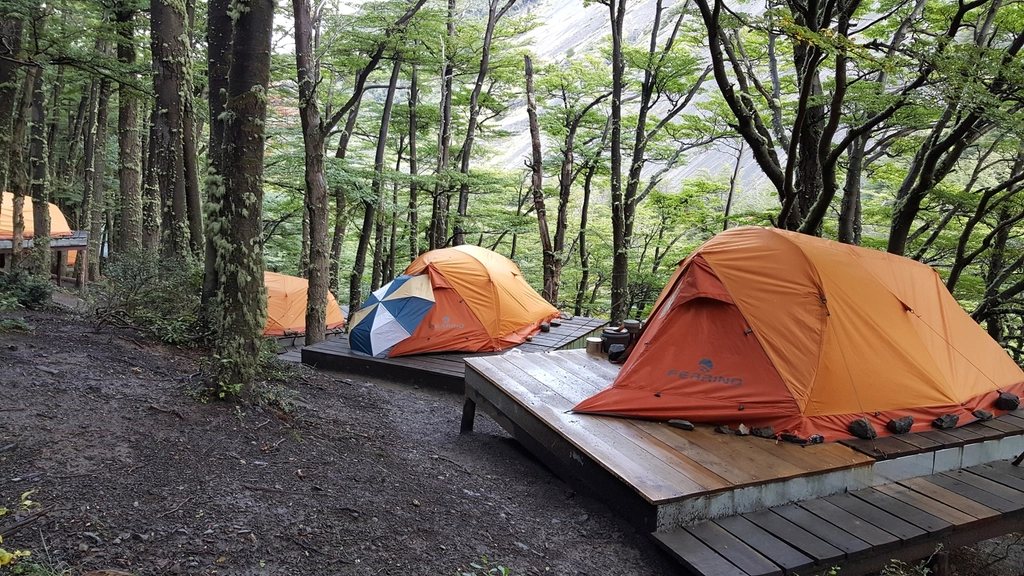
In the Chilean national parks camping is restricted to designated sites, and most of them have been placed in lenga forest or behind natural rises for good reason. Within the site, choose the most sheltered pitch you can find even if it is further from the water. Low ground behind a boulder, a hedge of stunted beech or a purpose-built stone wall is worth ten minutes of extra walking. Avoid pitching directly under mature lenga trees on a wild night; dead limbs come down in strong gusts.
On the Argentine side and on remote routes such as the Dientes de Navarino circuit near Puerto Williams or the Huemul circuit above the ice cap, you will pitch on open ground. Look for the lee of a moraine, a dry channel between hummocks or a patch of dense krummholz. A pitch that faces the setting sun is a pitch that faces the prevailing wind; the two are the same in this part of the world.
Pitching a tent that will still be there at dawn
A tent in Patagonia needs to be low, taut and fully guyed. Tunnel and geodesic designs with three or more poles cope well; tall single-pole shelters and ultralight tarps do not. Pitch with the narrow end, or the strongest end, into the wind, and never present a flat wall to it. Stake the windward corners first while a companion holds the fabric down, then work around to the lee. Every guy line goes out, at full length, at a low angle, and each is backed up with a rock. In gravel that will not hold a peg, tie the guys to buried rocks or to the trunks of scrub. Bring at least four spare pegs and ten metres of extra cord.
Once the tent is up, put the packs inside immediately and keep the door on the lee side. Cook in the vestibule only if the gusts allow it; in a real storm, cold food is the price of not burning the fly. At night the noise is the hardest part. A well-pitched tent that is flapping loudly is usually fine; a tent whose poles are bowing toward you needs a rock on the windward guys and possibly a rebuild in the dark. Do this early, not after a pole snaps.
The gear that matters
Clothing for wind is different from clothing for cold. A close-fitting hooded shell with a stiff peak, a warm hat that cannot blow off, thin windproof gloves and a neck gaiter turn a miserable day into a manageable one. Goggles or wraparound sunglasses are not optional on the moraines. Trekking poles with real baskets and unlocked wrist straps let you drop them if you fall. In the pack, a repair sleeve for a broken pole section and a small roll of tape weigh almost nothing.
When to stop
Some days the answer is to wait. Park rangers close the pass on the O circuit and the trail to the towers when conditions are dangerous, and they are right to. If you are on an unmanaged route, the decision is yours. A sustained wind that takes your legs from under you repeatedly, spindrift you cannot see through, or a companion who is frightened and tiring are all reasons to retreat to the last sheltered camp. Patagonian weather changes within hours. Wind that is unwalkable at noon is often a breeze by evening, and the towers look better the next morning anyway.